menu close

Sarajevo

The Jewish community of Sarajevo dates to the 16th century when the Sephardim who fled the persecution in Spain and Portugal settled in Ottoman-dominated Bosnia. By 1779 there were already 1100 Sephardic Jews in Sarajevo. The Austro-Hungarian occupation in the 29th century changed the fabric of the Jewish community in Sarajevo due to the migration waves of Ashkenazi Jews, who began to settle in Bosnia and Herzegovina for the first time in city’s history. After the First World War, Jews from the rural areas started to migrate to larger urban centers such as Sarajevo in pursuit of better educational and career opportunities.

In the three decades before the Second World War, the number of Jews in Sarajevo tripled. Out of the 14,710 Jews who lived in Bosnia and Herzegovina in 1931, 77,5% of them resided in the city of Sarajevo, thus making it the epicenter of Jewish life in Bosnia and Herzegovina. Just before the Second World War, Sarajevo had approximately 85,000 residents. Estimates of the Jewish population at the time range up to 12,400, 85% of whom were Sephardim, and 15% Ashkenazi Jews.

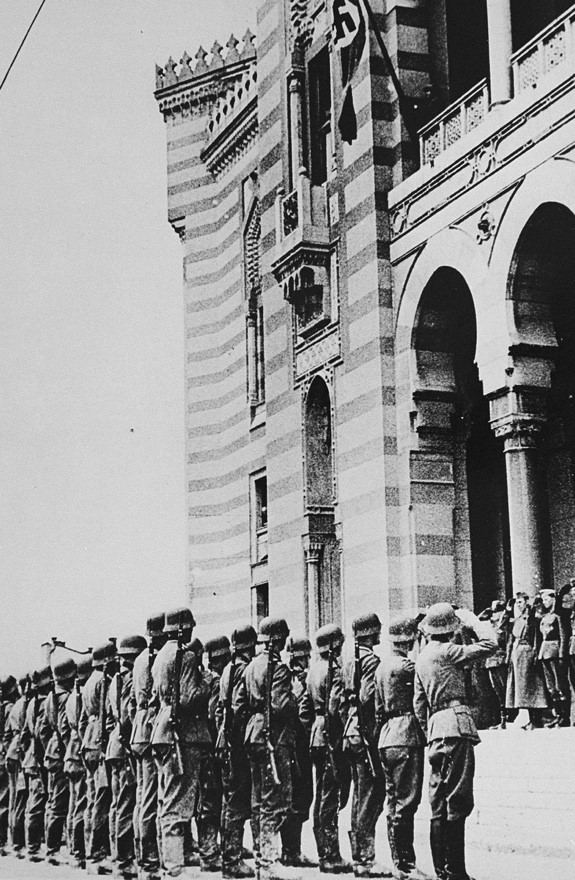
The German military entered Sarajevo on 15 April 1941. On the next day a pogrom was organized by the local German forces. During the pogrom, which witnessed the participation of many Sarajevo citizens, the Sephardic synagogue was demolished. German soldiers destroyed the inside of the synagogue by throwing hand grenades. They also burned the archive and the library of the Jewish Religious Community. Simultaneously, the Sarajevan crowd that participated in the pogrom stripped the synagogue of its massive copper roof.

image information
German troops salute during a flag raising ceremony on the balcony of Sarajevo city hall

The Ustaša regime was slow to establish its rule in Sarajevo. During the interwar period, the Ustaša movement had very little support among Sarajevan Croats. Nonetheless, in line with their aspiration to create a Greater Croatia, the Ustašas received approval from the Axis forces to include Bosnia and Herzegovina into the newly formed NDH. Bosnia and Herzegovina was officially annexed to the NDH on 24 April 1941. From this moment onwards, the Sarajevo Jewish community was exposed to systemic discrimination, persecution and violence. When the Independent State of Croatia was established, Jews in Sarajevo owned around 400 stores, 300 workshops and three large industrial complexes which employed more than 100 workers. Throughout 1941 all of these were seized by the Ustašas, who also robbed the Jews of virtually any other mobile or immobile property.

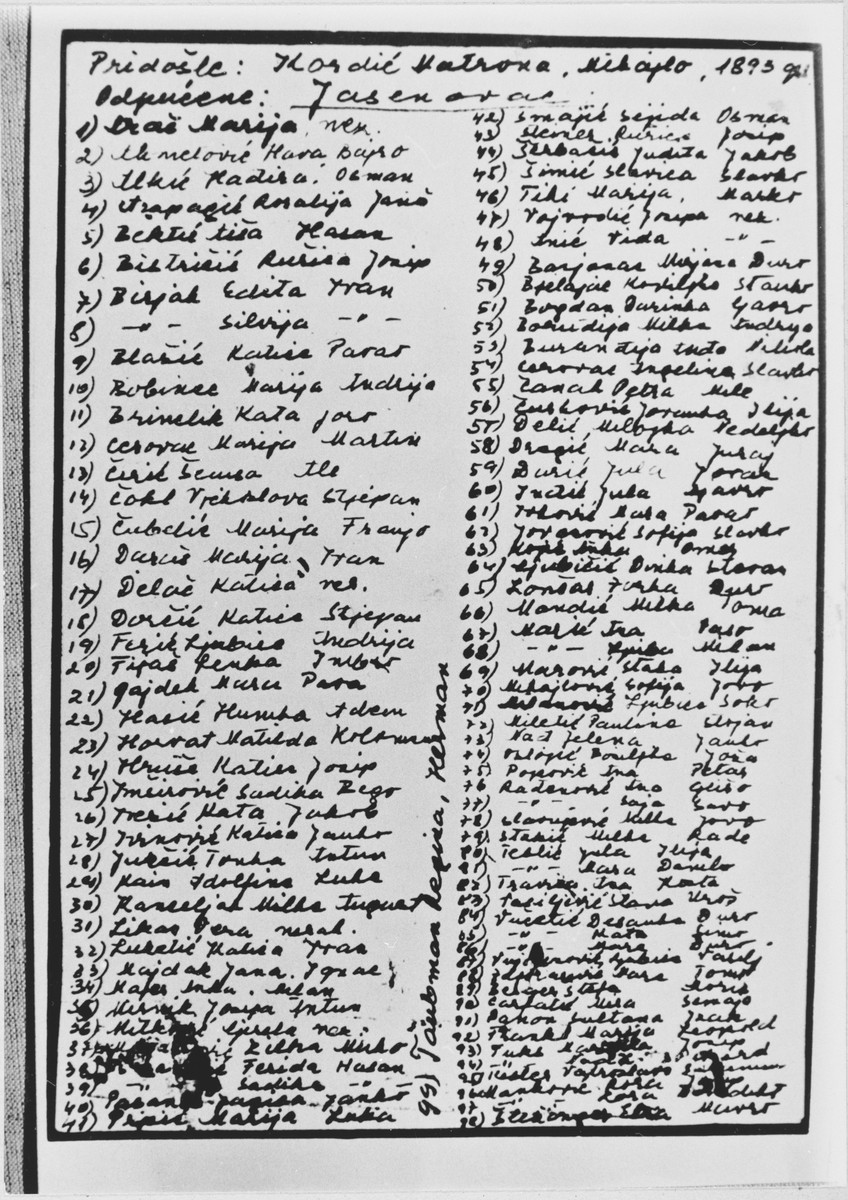
While individual acts of violence and executions of Jews started earlier, the mass deportation of Jews in Sarajevo began in September 1941. They intensified in October and reached their height in November and December 1941. Most Sarajevan Jewish men were deported to Jasenovac death camp, while women were mainly deported to the Đakovo concentration camp. In total, 9071 civilians died as the victims of “fascist terror” in World War II Sarajevo. However, Jews were vastly overrepresented as victims, and constituted 77% of all civilian victims in Sarajevo during the Second World War. Jews were therefore the only minority from Sarajevo’s interwar ethnic mosaic that never recovered from the devastating effects of the Ustaša rule.

Source Documents
Telegram Sent by Jure Francetić to the Minister of Interior of the Independent State of Croatia, Andrija Artuković, Relating to the Deportations of Jews in Sarajevo

Telegram Sent by Jure Francetić to the Minister of Interior of the Independent State of Croatia, Andrija Artuković, Relating to the Deportations of Jews in Sarajevo

Translated version here Themes: Deportations
Report On the Deportation of 300 Sarajevan Jews to the Jasenovac Camp Complex

Report On the Deportation of 300 Sarajevan Jews to the Jasenovac Camp Complex

Translated version here Themes: Deportations
Report on the Deportations of 395 Sarajevans to the Jasenovac Concentration and Death Camp Complex

Report on the Deportations of 395 Sarajevans to the Jasenovac Concentration and Death Camp Complex

Translated version here Themes: Deportations
Report From the Directorate of the Ustaša Police to the Grand Prefecture in Sarajevo Demanding a Temporary Halt to Deportations

Report From the Directorate of the Ustaša Police to the Grand Prefecture in Sarajevo Demanding a Temporary Halt to Deportations

Translated version here Themes: Deportations
Document Written by the Chief of Police in Sarajevo, Ivan Tolj, Demonstrating his Antisemitic Zeal

Document Written by the Chief of Police in Sarajevo, Ivan Tolj, Demonstrating his Antisemitic Zeal

Translated version here Themes: Perpetrator Perspectives
Testimony of Zlatko Mesić, the Intricacies of Local Decision-Making during the Implementation of the Holocaust in Sarajevo

Testimony of Zlatko Mesić, the Intricacies of Local Decision-Making during the Implementation of the Holocaust in Sarajevo

Translated version here Themes: Perpetrator Perspectives